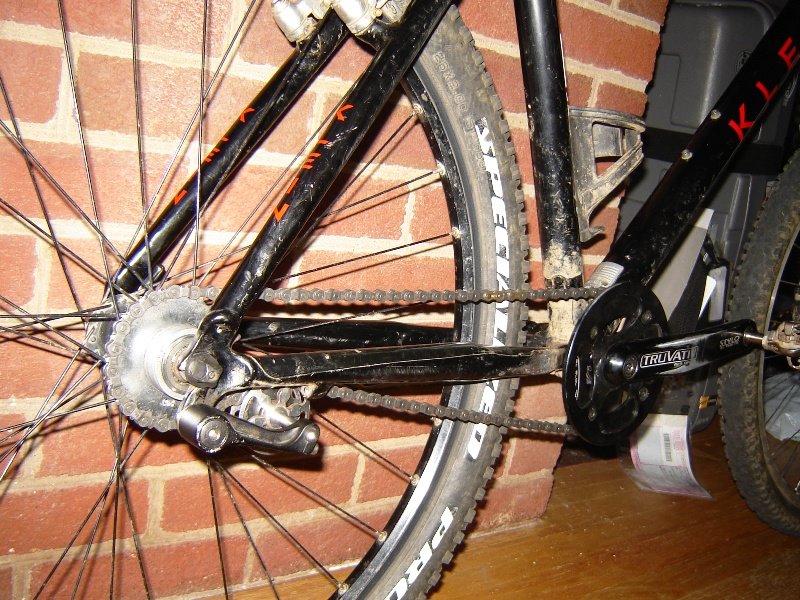
I don't usually get out of bed before 7:30 but had I was having all kinds of trouble with skipping on my single speed mountain bike last night and it was still on my brain. So, at about 6:30 I rolled out of bed and finished some of the research I started last night.
After I got my Full Suspension, I converted my older mountain bike into a single speed. Everything was running well until I loaned out the rear wheel. After I got it back, I put everything back together and when I test rode it, I had all kinds of skipping problems. You would think it would be easy to diagnose since there is only one gear to deal with. No such luck. I changed all kinds of stuff but the bike would still jump around under pressure. I thought about it for a while and decided to try one more switch. I changed to a bigger gear in the back which gave me two advantages over the previous setup.
Advantage 1: More teeth are engaged.
if you can imagine stretching a rubber band around a softball and a golf ball, there isn't much of the rubber band touching the golf ball. If you swap out the golf ball for a baseball, there will be more rubber touching the golf ball. Basically that's what I did, I used a slightly larger gear in the rear to get more chain contact.
Advantage 2: More teeth are engaged.
I can't just wrap a chain around the cogs and expect everything to work. I have to use a tensioner. You can see it in the pictures below.

Just because of the size of the cogs and length of the chain, I can make the tensioner push up on the chain, giving a little more wrap around the cog. When I used the smaller cog, there was too much slack to take up with the tensioner so I had to set it up in the pull down mode. This probably makes 2-3 less teeth engage the cog. (Just imagine the chain on the bottom of the silver wheel, where the arrow is)I think once I put some heavy tension on the pedals, the bike (or cranks) flex just enough to throw the alignment off enough so that is skips, but doesn't completely fall off. It's really annoying...but with the cog swap and using push up mode, I think I am ready to roll!
I was able to intuit most of the solution on my own, but there were two articles that I found that helped put it together. The second one has a nice simple way to measure chain line. A bad chainline can be the downfall of the singlespeeder.
http://www.surlybikes.com
http://www.sheldonbrown.com